John Smeaton FRS (8th June 1724 – 28th October 1792) was born and died in the family house in the Austhorpe area of the parish of Whitkirk. He attended Leeds Grammar School, leaving at 16 to work in his father’s law practice. He gave that up and became an apprentice to a mathematical instrument maker, setting up his own business around 1750. John Smeaton was given the accolade:- “The Father of Civil Engineering in Britain”.
His most famous work was the design and construction of a stone lighthouse to stand on the dangerous Eddystone rocks, an extensive reef in the English Channel approximately 13 miles south-west of Plymouth. This was the third lighthouse to have stood on the Eddystone, the first having been washed away during a storm in 1703 and the second destroyed by fire in 1755. “Smeaton’s Tower” was completed in 1759 and was operational for 123 years. When it was eventually replaced in 1882 by a new lighthouse, “Smeaton’s Tower” was dismantled and rebuilt on Plymouth Hoe as a memorial. The tower was designated a Grade 1 listed building in 1954 and is now a tourist attraction. Between 1860 and 1894 the design of the reverse side of the old penny coin used to show a depiction of Smeaton’s Eddystone lighthouse.
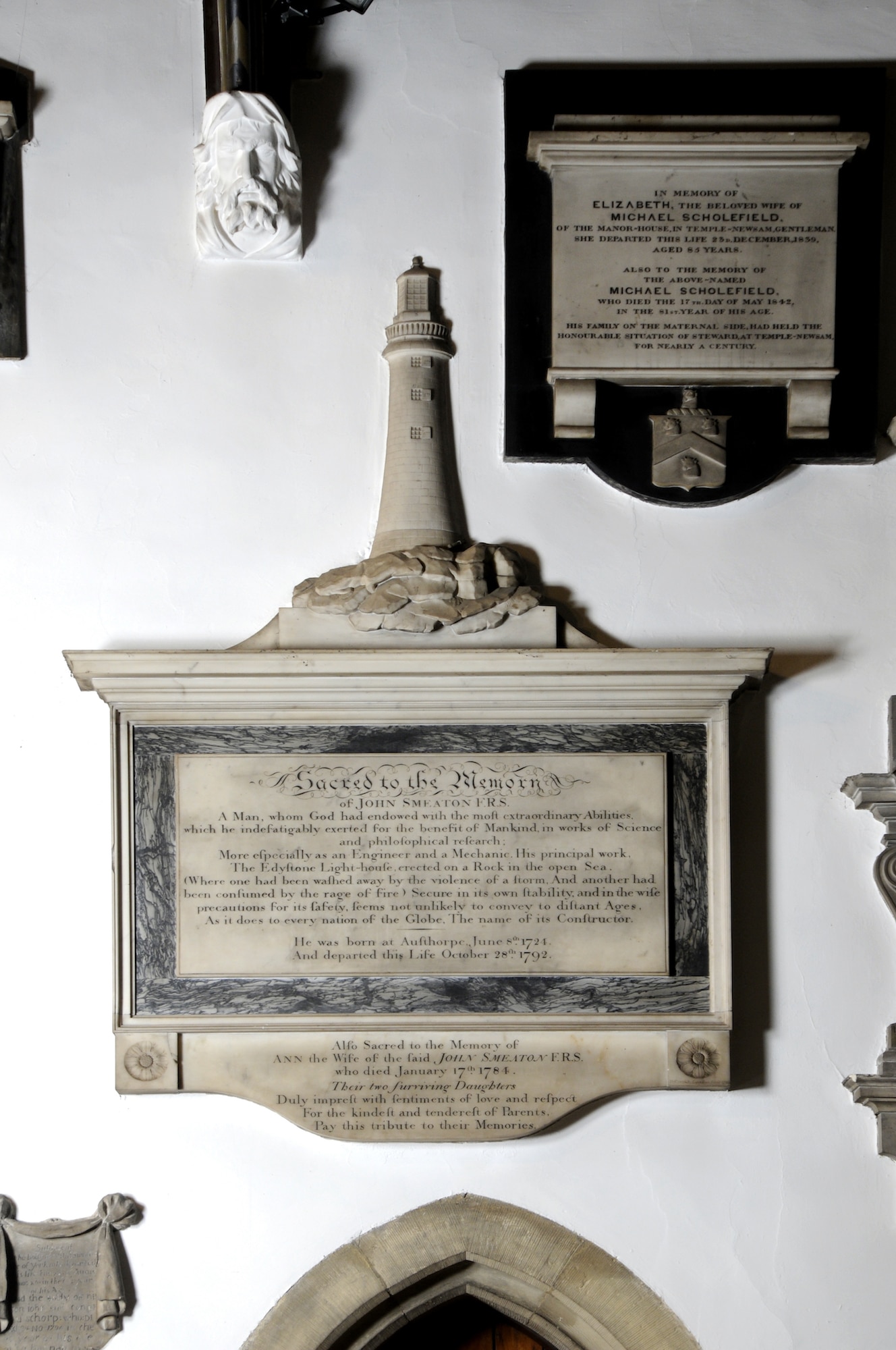
John Smeaton died after suffering a stroke whilst walking in the gardens at his family home in Austhorpe and was buried at St Mary’s Church Whitkirk. His tomb lies beneath the altar, and there is a small plaque on the floor to mark the location. On the north wall of the Church, above the sanctuary, there is a larger stone memorial to John Smeaton and his wife.
On 7th November 1994 Noel Ordman, President of the Smeatonian Society, unveiled a memorial stone to John Smeaton in the north aisle of the nave of Westminster Abbey.
An image of Smeaton’s Eddystone Lighthouse continues to be used by Austhorpe Primary School – located next to the site where John Smeaton’s house once stood – as part of their school badge.